Published on
Last modified
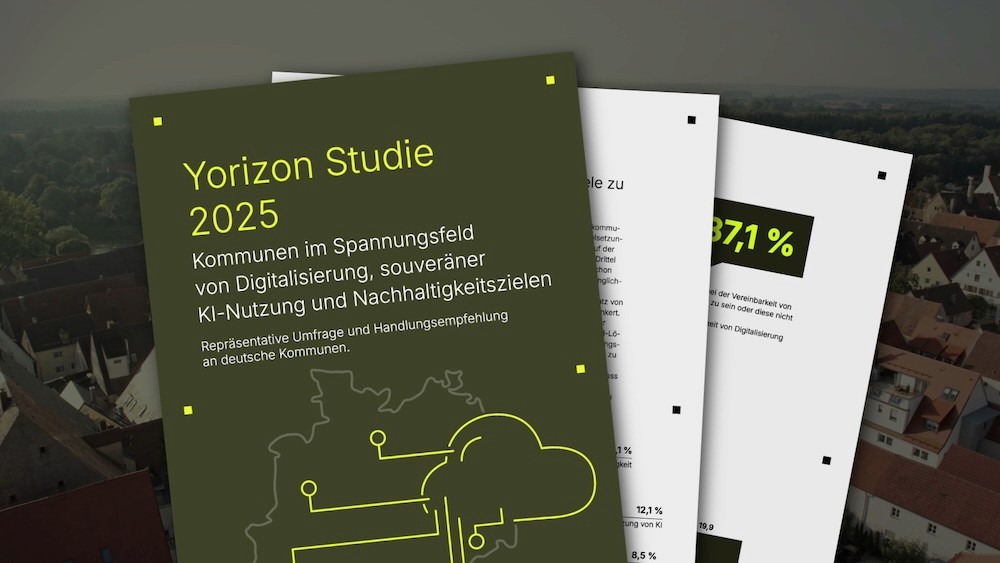
Yorizon publishes study on municipalities
New Yorizon study reveals a lack of strategies and goals for digitalization, AI, and sustainability in German municipalities. Urgent action is needed.
Read Study Now

The nationally representative Yorizon Study 2025 shows: Only one in five municipal decision-makers sees their municipality as well prepared for digitalization (18%); for AI it is only one in ten (9%).
One in four said (23.4%) that they do not have any specific goals in the areas of digitalization, sustainability and AI use. One in five (19.5%) did not know whether there were goals on this topic.
Only a good third (35%) of municipal administrations have a defined strategy for defending against cyberattacks.
Green IT is more of a “nice-to-have” status.
Berlin/Vienna. 22.10.2025 In most municipal administrations there is uncertainty about what to expect regarding the future topics of digitalization, AI and sustainability. There is either a lack of strategies and goals, or the current status is not known – according to the nationwide representative Yorizon Study 2025.
The survey of 1,500 decision-makers in municipal administrations was conducted by the market research institute Civey on behalf of the cloud provider Yorizon from July to August 2025. The results cast a spotlight on the urgent need for action in public administrations to meet the requirements of digital sovereignty, secure AI use and climate neutrality.
For future topics, concrete goals and preparation are often lacking
Of the municipal administrations surveyed, one in four said (23.4%) that they do not have any specific goals in the areas of digitalization, sustainability and AI use. One in five (19.5%) did not know whether there were goals on this topic. In addition, only 18% of respondents said that their municipality was well prepared for digitalization; for sustainability goals, 21% said yes and for AI only 9%.
“Interesting is that those who have formulated concrete goals in one of the three future topics and at least communicated them at management level often also link them with the other fields,” explains Andreas Schweinar, Co-CEO of Yorizon. “These municipalities seem to have a deeper understanding that precisely from the interplay of digitalization, intelligent processes and clear sustainability goals valuable synergies, innovative impulses and higher value creation from investments arise.”
AI use still in a rather ad hoc trial stage
Not even one in ten sees itself as well or rather well prepared for the use of AI. At the same time, just under 40% said they already use AI or are gaining initial experience with it. Most municipalities are therefore still in the AI trial stage, few have concrete plans for secure, broad deployment. However, this currently rather ad hoc use of AI entails a variety of legal and strategic risks, which the municipal decision-makers surveyed also seem to be aware of – data protection risks and a lack of expertise are named as the most important critical aspects.
It is also noteworthy that the lack of standardization in AI is not a problem for most, whereas dependence on external providers is a central counterargument against AI. “This shows that there is still a considerable need for education and action with regard to AI,” Schweinar continues. “In particular, standardization can ensure for AI applications that no dependencies on individual providers arise and thus cost traps are avoided. Standardization is also the key prerequisite for implementing and monitoring basic legal and ethical regulations in AI applications.”
Hardly any strategies for cybersecurity
Only 35% of the decision-makers surveyed can currently answer the question of whether their municipality has a strategy for defending against cyberattacks in the affirmative; over 40% know nothing about it. The digital security risks faced by municipal administrations in particular, with highly sensitive personal data, are therefore by no means yet being taken into account nationwide. This question also makes clear how important the current state of digitalization is. Among respondents who feel well prepared for digitalization, 71.6% said that IT security is also in place.
Need to catch up on knowledge of modern IT solutions
Overall, the survey shows that the view of IT infrastructures in municipalities is still very much shaped by the classic operation of their own data centers. But especially on the path toward a higher level of digitalization, municipalities can benefit from demand-oriented, decentralized data center services and cloud solutions – for example, in order to implement IT modernization in an accelerated, secure way without major investment hurdles. 43% of respondents consider locally operated, cloud-based data centers a realistic alternative to traditional data centers. The approval rate is roughly the same across all respondents, regardless of their maturity level in digitalization, AI or sustainability.
Sustainability has “nice-to-have” status
Sustainability in IT still seems to have more of a “nice-to-have” status for many municipal decision-makers; it plays a secondary role in the criteria for selecting cloud data centers. It looks a little different when asked directly: Almost half (45.9%) of the municipal decision-makers taking part in the survey would prefer data center providers if this meant more sustainability in IT. For one in five (21.6%), this is not a relevant topic. This shows that there is a need for greater awareness of the rapidly increasing energy and resource demand caused by IT and AI, and for concrete strategies to counter this development effectively in municipalities with modern IT and infrastructure solutions.
“To meet the requirements of digital sovereignty and climate neutrality, municipalities need future-proof IT infrastructures,” Schweinar concludes. “The necessary components are available to design and operate these in a climate-friendly and economically efficient way. In particular, local, sustainably designed cloud data centers will play a central role in overcoming the limitations of their own data centers and in operating sensitive municipal applications securely and independently. With the modernization initiatives currently underway in the municipalities, they have the opportunity to pursue an integrated solution path for pressing future issues regarding digitalization, sustainability and AI with innovative concepts for IT infrastructures.”