Published on
Last modified
Digital sovereignty requires continuity
The new ALASCA white paper shows how Europe can achieve digital independence. It highlights initiatives such as Gaia-X, SCS, and IPCEI-CIS, with clear recommendations for policymakers and businesses.
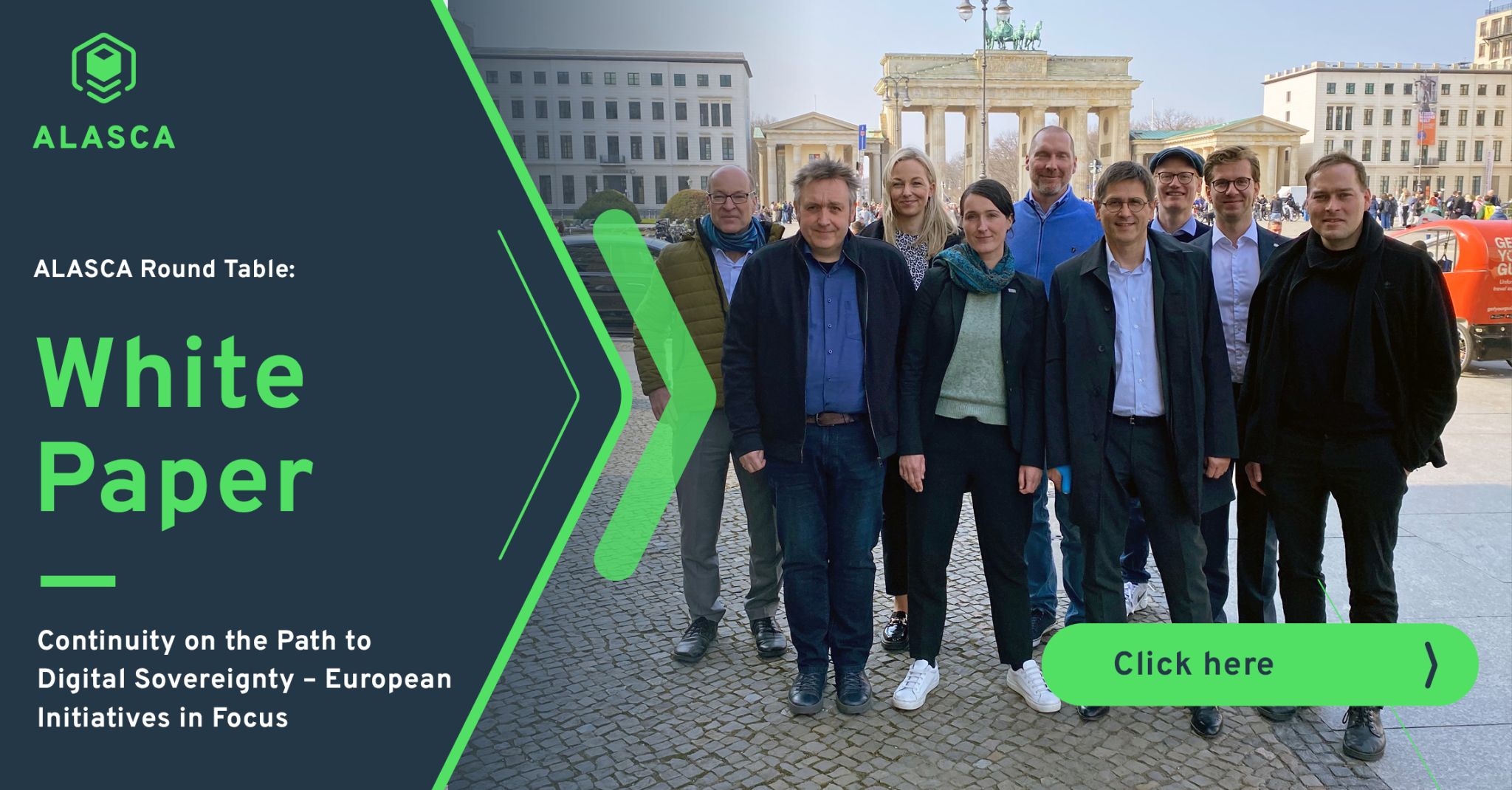
The whitepaper *“Continuity on the Path to Digital Sovereignty – European Initiatives in Focus,”* published in June 2025, examines key programs such as Gaia-X, Manufacturing-X, IPCEI-CIS, the Sovereign Cloud Stack (SCS), and the 8ra initiative — while raising one crucial question: How can we ensure the long-term effectiveness of these efforts?

A wake-up call for Europe’s cloud initiatives
Europe stands at a critical juncture: While US and Chinese tech companies dominate global digital infrastructures, the pressure to create its own independent structures is growing. The recent publication by the association ALASCA e.V. captures this challenge precisely—and provides a well-founded analysis of the state and future of European cloud initiatives.
A shared goal, many challenges
The goal of all initiatives is clear: a secure, interoperable and trustworthy digital infrastructure built on European values such as data protection, openness and transparency. Yet implementation is complex—the political ambitions meet technical reality, sectoral differences meet coordination problems, bureaucratic hurdles meet international dependencies.
The withdrawal of Nextcloud from Gaia-X, for example, shows how fragile such projects can be when governance, participation and clear target visions are lacking. At the same time, the networking of initiatives—for example between Gaia-X, IPCEI-CIS and SCS—offers great opportunities for a more strongly integrated digital Europe.
A clear call for collaboration instead of silo thinking
At the center of the white paper is the evaluation of a press talk on 25 March 2025 in Berlin. There, leading figures from business, administration, open source and the mid-sized business sector came together—including Gernot Hofstetter, our CEO at Yorizon. The discussion made one thing clear: Digital sovereignty does not emerge from isolated initiatives or political flagship projects, but through structural continuity, pragmatic collaboration and shared standards.
“We want to be part of a movement that is bigger than ourselves — open source creates exactly that kind of collective space,” says Hofstetter in the whitepaper.
Other voices such as Ernst Stöckl-Pukall (BMWK), Felix Kronlage-Dammers (SCS) or Miriam Seyffarth (OSBA) also make it clear: The future does not lie in new symbolic projects, but in the consistent expansion and interconnection of existing solutions – from open source and interoperability to standardized data spaces for industry and the mid-sized business sector.
Open source as a strategic lever
One of the central theses of the white paper: Open source is more than just a technical decision – it is a strategic model that enables independence, transparency and innovation capability. “Public Money, Public Code” must become the standard, it says repeatedly. Only in this way can both digital sovereignty and economic resilience be secured in the long term.
Who is this white paper particularly relevant for?
The white paper is aimed at:
Decision-makers from business, administration and politics, who are working on sustainable digital strategies
IT managers and cloud providers, who want to promote European alternatives
Medium-sized companies, who have so far found no tangible entry points into the European cloud landscape
Civil society actors, who operate at the interface between technology, governance and the common good
Our conclusion at Yorizon
We welcome the white paper's clear focus on continuity, open source and collaboration. As an active member of the community, we see every day how important long-term viable structures are—and how much potential lies in a networked European cloud economy.
The full white paper is now available and provides valuable impetus for the strategic development of European cloud initiatives: